|
Transit
Needs & News, Task Force materials
A
service of the Hyde Park-Kenwood Community Conference Transit and Parking
Committee and the HPKCC website, www.hydepark.org
Help support our work: Join
the Conference!
Join
the Transit Task Force-contact chairman James
Withrow. |
Our Transit website
has been reorganized. Please visit successor page Transit
Needs. To Transit website home.
Transit
home page. About
the HPKCC Transit Task Force. Contact us. Contact
chairman. Chairman's
transit blog.
Most news is now either
in the Transit homepage or the topic
pages given below.
In
this page:
To
Bus changes home
including Task Force statements.
To
Task Force 2004
Bus Routes and CTA Funding Workshops
To more on the CTA agenda of the Task
Force, meetings with CTA managers and planners
To more on the CTA
funding and bailout
To Chicago smart Cards and universal
card prospects
To
'SECRET',
other plans for Metra Electric enhancement
To Gray Line Metra Electric plan home
To January 27 House southeast transit
hearing (consultations with legislators continue)
To Metra Stations, Metra
improv'ts background. Metra
viaducts, walls, Lake Park corridor
To Bicycling
and bike routes and maps
To Dan
Ryan plan issues
To Red Line Shuttle and what was
implemented instead
To Parking Woes and Hopes
To Walkable Community page
To Walk to School
page
The
big picture today
The transit agencies
are cutting projects in light of a growing capital shortfall- and guess who
gets hurt the worst by Metra?
Metra is cancelling
the new Electric Line 143-car fleet that
included toilets for the only line lacking them, a lack that was cited by
our elected officials as evidence of neglect of the southeast corridor and
inner city and African American residents. Now we are stuck with an aging
fleet. Also cut is a new fleet maintenance facility near University Park.
CTA has cut planned
purchase of busses, railcar overhauls and trin signal improvements.
Congress did
increase aid for Illinois Mass Transit by 28% (vs national average 45%) but
the lack of significant increase for Illinois combined with the end of IllinoisFIRST
funds ($260m a year) means a drop in RTA capital allotment this year from
$900m to under $500m. If RTA can't scrape together another $125m match to
garner a federal $500m, the capital allotment will fall under $100m in 2006.
So the agencies
are going to Springfield again. But Rep. Hamos, one of the biggest voices
in transportation, says there is no legislative consensus and any new funds
must be part of a package of reforms in funding and spending. As quoted in
Crains, "There's legislative interest that there be no federal
dollars left on the table. What the federal bill has done is provide us with
an incentiv eto set at he table to come up with a solution."
Issues
and goals as identified by the HPKCC Hyde ParkTransit Task Force and others
| Transit |
Parking,
pedestrian and bike friendliness
|
| |
|
-#
6 Jackson Park Express Bus Dtn to 79th/So Sh
Service that is sometimes still spread too thin-and-seldom
(esp. south of 63rd) but has gained enormously from reconfiguration and
addition of more routes, esp. rush hour X28.
-routing
of buses, particularly Lake Park viz a viz S. Hyde Park Blvd. From
hearings to Task Force Workshops to aldermanic complaints, a majority
including businesses, high rises and residents on gridlocked S HPB,
thinks the #15 should return to Lake Park.
-ensuring
buses use technological means and management to properly time arrivals
and service level
-Other
route improvements incl. #4/X4 by Michael Reese and late at night, late
night dependability for #55, 173, comprehensive look at transport and
transit options in the neighborhood including handling the U of C volume.
-Bus
shelters- there are still a few corners with significant numbers catching
the bus that do not have shelters.
A
few bus drivers still seem not to take command of unruly situations
although most drivers are
-Metra
service improvement and long term hope for a closer
and more useful linkup of Metra Electric into CTA and other area transit:
South East Chicago Rail Enhancement Team (SECRET or' Gray
Line Lite'). (10 minute headway 7 am-10+ pm,
30 cent CTA transfer/universal card) Being coordinated
with other organizations and communities in the southeast corridor.
- Metra
station and vicinity rehab and upkeep, full fleet of new cars with toilets
- Metra
viaduct rehab, completion of embankment rehabitation
-Lakefront
access from 57th beach north at regular intervals over Lake Shore Drive
Streetscape
improvements.
|
53rd
St parking proposal
See
TIF News &
Zoning (reform
proposals also look at transit-oriented/transit node development;
53rd has been designated a Transit Node (others should be considered)
in the new Zoning code and 53rd Lake Park-Kenwood a special Pedestrian
Oriented Commerial Zone.) Key was thought to be getting a new garage
(preferably with retail below contributing to transit-oriented development).
This depends on new construction showing use-demand and a TIF-income
stream to support bonds and was in turn tied to an addition to Canter
Middle School. This seems stalled or derailed and so other
means of maximizing parking in the main commercial area will
and should be being considered. Meanwhile, the UC is adding parking
on it south end.
Walkability,
bikeability...and compatability between the two! is
of importance to the the community. The matter is complex, from keeping
bikes off sidewalks to optimizing safe intersections and (reduced)
curb cuts to getting potholes and sidewalks fixed.
|
| |
|
Top
Needs,
news and agenda in more detail...
An
exploration under Gov. Blagoevich of a superagency for all northeast Illinois
may or may not be going forward.
RTA as we know it and Pace would be eliminated. Likewise CATS and NIPSI
planning bodies would go into RTA or into the Department of Transportation,
under the governor's control. Yet the legislature as a whole is loathe
to address long-range, permanent state funding laws for transit--the very reason
reason for impatience with the RTA Act.
In
the end, the review committee did recommend merging Pace and Metra and some
other coordinations but shied away from a superagency or visiting the regional
formula for tax allocation to the service agencies.
Top
See bus
route reconfiguration for description of the bus route changes that have
been going into effect and refined through 2003 and 2004.
These changes to the whole lakefront market, where ridership
is increasing do, it seems, strengthen ability to get around faster, at more
times (at least in some cases), and with fewer transfers.
Routes are tailored more to the needs of smaller geographic and niche markets
and more geared to getting people downtown and to connecting lines. The restructuring
incidently may give Metra a run for its southeast side market. See
the link for details and drawbacks.
Speaking
of Metra...the stations and more, that is..The
August, 2003 "expected" re-start of work was two years off the mark
and finally in August, 2004 the last station, 53rd reopened--and there aren't
even ticket vending machines at 55th and 56th then.
See latest. The
community's many organizations and aldermen, led by South East Chicago Commission
and including a Conference representative, Jane Comiskey, started demanding
station upgrade in the early 1990s and worked for many years to convince Metra
to upgrade its stations in Hyde Park. Starting in 1998, HPKCC's Transit Task
Force also lobbied for this and critiqued elements of the plans presented by
Metra at a series of public meetings. Metra proposed a $12 million investment,
in part to provide ADA compatibility and consolidate the main stop in the center
of the neighborhood. After long delays and with fits and starts, the 51st and
57th stations finally opened--fortunately being the ones with elevators.
Worries
remain about security on the new stairs, elevators (at 51st and 57th) 51st and
53rd seem the most worrisome, but there have been incidents at 47th, too. Neighbors
of the 57th station remain wary about commuter parkers, who have created problems
near 59th and 56th.
Below:
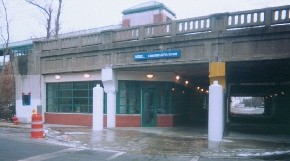
57th Street Station. Possible retail space is visible in left frame.
Commuters are
asking for badly-needed stopgap repairs and improved security at 59th and a
start of planning for general improvements to the station, platform, and viaduct
below. The latter is the subject of interesting design concepts in the Chicago
Park District/University of Chicago Master Plan/Midway Plaisance. Police patrols
were stepped up because of incidents on the platform. Alderman Hairston seeks
reopening of stair access at 60th Street, where the U of C built a public commuter
parking lot. Campaign for Better Transit and Woodlawn groups want to take advantage
of repairs at the 63rd station to market the station and make it a regular flag
stop. As part of the SECRET project, the Transit Task Force supports
rebuilding of all older stations on the South Chicago Branch. 2 now starting
are in South Shore at Stony Island and Bryn Mawr.
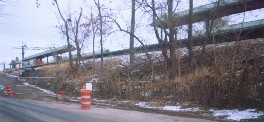
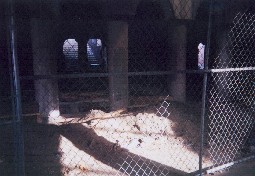
Work in progress:
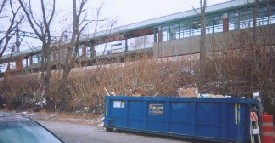
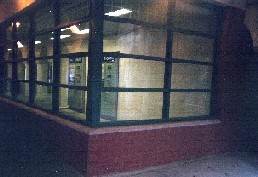
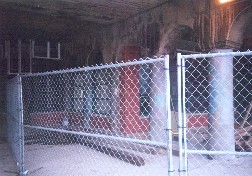
56th lower station, platform 57th-57th, 53rd as of December, 2002
TIF Advisory Council
and aldermanic task forces, with Metra funds and CDOT, planning grant in hand,
continue to study and seek funding for refurbishment of the uninviting Metra
and Canadian National viaducts. (There are differences of opinion on preserving/replacing
murals. At least the one at 56th is being preserved. Many of the murals do not
last due to water seepage and exposure or are in the way of stabilization work.)
With Metra having taken out turnstyles, it is unlikely there will ever
be ticket attendants at 51st and 57th, considered by many necessary to security
and good upkeep.
Istria
is to open coffee shops (having toilets) late this summer or fall in the 51st
and 57th stations.
Metra
expects the first 26 new electric cars late in the year, part of a ten-year
replacement program for the entire fleet--now blocked by expiration of a state
bond program.
Metra
is cracking down on spouses using the same pass--but the solution, making passes
gender specific looks goofy and maybe unconstitutional? Wouldn't individual-specific
be better? Meanwhile, the grace period for those not renewing passes is reduced
to a half day, and those who board trains without passes and without buying
from the station's machine or ticket seller will be charged $2 extra.
_________________________________________
Letter
from Richard Gill to the Herald, April 16, 2003 re: a strong article criticizing
Metra station delays.
Metra headline
wrong
To the Editor:
Your April 9 story
about the delays in Metra staion reconstruction has a headline "Metra:
Long Wait for Trains." The headline is grossly misleading. It suggests
that Metra has reduced its train schedule and created a longer interval betweeen
trains. In fact, Metra ha not reduced its train service at the 53rd or 57th
St. staions at any time during the station reconstruction period, and their
servie has continued uninterupted during that time.
The Herald's story
quotes a communtter as saying that Meta may suffer a permanent reduction of
ridership as a result of the construction delays. Your headline, which wrongly
suggests that train service has been degraded, coul have the same effect.
Top
I-GO
(car-sharing) available in Hyde Park
Visit our new
I-GO Carsharing page.
In September 2005,
I-GO celebrated expansion of its Hyde Park fleet in a system expanding city
wide, partly as an antidote to high gas prices.
In November, the TIF Parking Committee heard a presentation from I-GO.
A unique, new
car-sharing service that lets you drive when and where you want, just like owning
a car. You have 24 hour a cess to I-GO cars located in the area. After signing
up with the required avouchments and paying the $75 initial registration fee,
reserve a car for 1 hour or more, and pay $6.00/hour plus $.50/mile. I-GO pays
insurance, maintenance, etc. To apply online, visit www.i-go-cars.org.
To receive an application or information by mail, call (773) 278-4IGO x227.
I-GO is now located in the following communities: Andersonville, Edgewater,
Hyde Park, Logan Square, and Wicker Park, Uptown, River North, E. Lakeview,
and the Loop with more likely to come--1000 members and 25 cars by early 2005--both
goals now reached. Hybrids are also now included in select sites.
Center
for Neighborhood Technology is launched the program then reached out to
the local transportation planning agency CATS. The operation is run by a firm
very successful in Washington, D.C. CTA has recognized the value--program
users are far more likely to use public transportation and bus/train use goes
up when the I-Go cars are stored nearby--so CTA is setting up new I-GO
park-and-get spots in lots by its stations and routes. Also, a federal CMAQ
anti-congestion/anti-pollution grant and a grant from LaSalle will allow fleet
doubling and enable the program to be operationally self-sustaining by a couple
of years. The $410,000 spring 2004 grant will enable doubling the Honda
sedan fleet and location in more neighborhoods. CDOT is highly enthusiastic,
according to its spokesman Brian Steele.
There are now 27 vehicles
and 15 sites. Cars in Hyde Park are located in the 53rd St. Lake
Park city parking lot in the University of Chicago parking lot at 55th and Greenwood.
Additional cars will be added in Hyde Park as needed according to CEO Sharon
Feigon, who noted that Hyde Park was one of the early participating communities.
I-GO was early touted by Hyde Park-Kenwood Community Conference, our Aldemen,
and the Hyde Park Chamber of Commerce.
Walkable
community, pedestrian-friendly 53rd Street, transit-oriented development, Lake
Park Corridor and viaduct project.
Visit
the Walkable Communities page for
more.
The HPKCC
Transit Task Force wants to see that some of the most
attractive advantages of this community are maintained and enhanced. The ability
of people to walk or bike to work, the store, events- or to move about recreationally-
are increasingly pressed upon by both traffic congestion and its opposite: fast
moving traffic on Lake Park, 55th, and other "auto oriented" arterials.
The parking crunch and dilemma (add more and more traffic comes) add to the
problem. Some of our intersections including along Lake Park are not well designed
the handle this multiple challenge. Recently, studies and recommendations have
been made for Lake Park. No funding is yet available, but there is funding to
start rehabilitation of the dreadful (and in significant ways unsafe) Metra
viaducts. Also to rehabilitiate the Metra embankments and retaining walls.
Some streetscape
improvements have been made on parts of 53rd and 55th Streets. It is proposed
in the Zoning Reform Ordinance to concentrate on keeping 53rd Street pedestrian
friendly and taking advantage of enhancements for transit-oriented development.
(New bus routes including on Lake Park at the commercial center and advocated-upgrades
to Metra service may help- Hyde Park is at an ideal distance from downtown and
termini along major road and rail corridors. But the many new bus routes in
the neighborhood ply frequently narrow and at times of day congested streets.
And why does the pedestrian-friendly zone for 53rd not extend west of Kenwood?)
Top