Kids
and Games: CAGL's Natural Combination
by
Rita Yacker
If
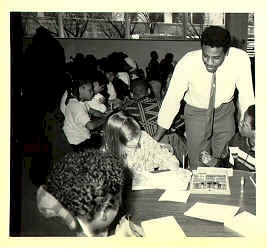
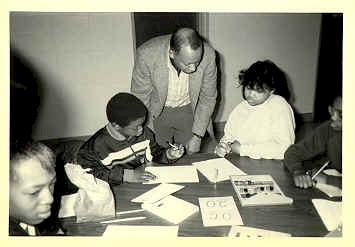
you should visit a Saturday tournament of hte Chicago Academic Games
Leage at the U-High cafeteria, you would find a cavernous room full
of middle-grade children and you would hear nothing but an occasional
crumple of paper or the scrape of pencils moving quickly across paper.
No electronic beeps or dings or clicks--nothing but brains geting their
juices flowing, whatever that sound may be! At times, there will be
a hand in the air, the signal tha a player needs a judge to help settle
an issue, part of the arbitration process that is an integral
piece of the whol package in the playing of the games. That's not surprising
when one considers t hast the author of the game was a law professor
at Yale.
Layman
Allen, the professor, as trying to teach law students to theink purposefully
and logically in their written and oral arguments. To this end, he invented
WFF 'N PROOF (logic) and then EQUATIONS in a game form that students
could play together and teach each other, all the while taking responsibility
for their own conclusions and processes by keeping score.
Rules
are an essential part of the package: rules of thegame, rules of Math
(in Equations), and rules of civility. The rules key to the variables
the kids have to keep in their heads as the play progresses. Academic
Games is not contact sports. Every move is orderly and "by the
book." The point of the game is to be the last player left with
a viable solution, within the time allowed (a timer is part of the game).
Observers will see a playing mat shared by three students, holding colored
wooden cubes with symbols on them: number 0-9, and the four math operations
plus square root and exponent. Closer observation wil reveal that the
playing mat has four large sections: the largest is resources, which
has to hold a random "shake" of all 24 colored cubes to start
the game. Under the resources spot are three sections lableled
forbidding, permitted, and required. As each player
takes a turn, a cube is moved to block an oponent or enhance the player's
(mover's) chances.
This
is the genius of the game. Making decisions is critical in the game
and in life, and so is taking responsibility for choices made. The playing
mat, with its model of decision-making, has been used by me in strategizing
in the community or personally to evaluate choices and what is viable.
Program Director James Wilson calls it the "Game of Life"
when he speaks about the program. It makes a powerful statement, keeping
argument to a minimum and conclusions clearly defined.
Substance,
discipline, teamwork, and good sportsmanship are all fundamenal to the
games and have been so for the 25 years we have run it. The individual
school may bring as many kids as the sponsor designates, enourging teachers
to include youngsters at all levels of math ability. The content of
the games fills needs at both the upper and lower ranges of ability.
Organization of the teams is another critical difference that sets CAGL
apat from other activities. There is always movement during the tournament,
at the end of the rounds. No child is frozen inplace by his or her ability.
The goal is to keep kids playing at the limits of their ability without
being wiped out by opponents. Teachers rank their teams and opponents
from other schools are matched so that kids are challenged and comfortable
at the same time. Teachers must be sensitive, informed and supportive,
a requirement that actually makes them better classroom teachers.
Over
the years, administrators of various sorts have asked us for evaluations
of the program. We have never had the resources to do an evaluation
of the type they refer to: the quantive (and often meaningless) drone
of how many did this, what scores they made on the Iowa Tests afterward,
and all that goes with that. With this much experience, what keeps us
enthusiastic is that everyone participates voluntarily: teachers, students
, and the Games organizers. From time to time, we hear of our alumni
who remember their experiences with the progrm very vividly. In the
past year incidents of our impact on young liveshave increased so much
that we realize tht we have grown our own cadre of teachers in the Chicago
Public School ranks. The mature young people are now createing a new
wave of second-generation players as they as they contact us to join
the League. They have told us that, although they were from different
scxhools and frequently did not know one another prior to their encounters
at workshops, area meetings, or professional development programs, their
enthusiasm has always been keen, evoking the recolections of the Invitational
at Lake Geneva, the meets at U-High, and the sponsors that guided them,
providing mentoring and mdeling.
In
our dealings with both children and adults, we emphasize that our standards
and requirements are based on fundamental good sense. The new crop of
teachers wer have grown underscores our good instincts were trustworthy.
For
information about the monthly Saturday tournaments at u-High, October
through April, and the weekend in Wisconsin in May, call the Conference
(773-288-8343) or Rita Yacker (773-363-0328). Students in grades 5-8
may join only as pat of a school team, with a teacher-sponsor
from that school. Games may be ordered using the same contact numbers
as above.
Top


 Slightly
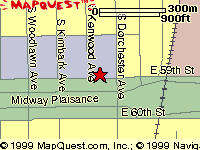
inacc. Lab School loc.
Slightly
inacc. Lab School loc.